
Woodwind
The collection includes more than 200 woodwind instruments dating back to the mid 18th century and ranging from whistles, piccolos and flutes to oboes, flageolets and clarinets.
Traditionally called woodwind as they were made of wood, instruments within this classification can be made of both wood and metal. Like the brass classification these instruments are are grouped by the way they make sound. However, unlike brass instruments where the player creates the vibrations, the woodwind sound is made by a narrow stream of air from the player passing through reed, this creating vibrations, within the instrument itself.

Band flute, 1890
This band flute has six keys and measures 30.5cm. It is made of three sections of hardwood with four bands of German silver. It was used by Band Sergeant Archibald Trolley in the Crimean War in 1854.
(MAM1:0049)

Band Flute with 6 Keys, 30.5cm, 1890 (MAM1 0049)
Alto Flute, 1998
This flute was made by George Potter & Co, Aldershot. It was played by a member of the 7th Battalion, Cheshire Regiment Corps of Drums.
(MAM1:0499)

Alto Flute (7th Btn, Cheshire Reg CoD) by Potter, 1998 (MAM1 0499)
Oboe, 1925
This oboe was made by Jacques Albert of Brussels and London. Jacques was the son of Eugene Albert (1816-1890) who was a reknowned Belgian maker of woodwind instruments and in particular, clarinets.
(MAM1:0052)

Oboe by J Albert, 1925 (MAM1 0052)
Oboe, undated
This oboe was made by Lahousse and is stamped Cahousac, 41 Haymarket, London.
It is made in three sections of boxwood with twokeys in German silver and two bands of ivory. It has two sets of double holes in addition to single holes producing F, F# and G#. This is characteristic of oboes made between 1660-1760. It measures 22.5 inches.
(MAM1:0056a)

Oboe by Lahousse Made in Boxwood, 22.5 inches (MAM1 0056a)
Whistle Pipe Bb, undated
This whistle pipe was made by Samuel Barnett & Son, London. During the 19th century Barnett is listed as a ‘Harmonium Manufacturer and Manufacturer and Importer of Flutes and Registered Cylinder Flageolets’
Known as a penny whistle, these instruments were used extensively in the British Army until modern times. It is made of brass and measures 35.5cm.
(MAM1:0024b)
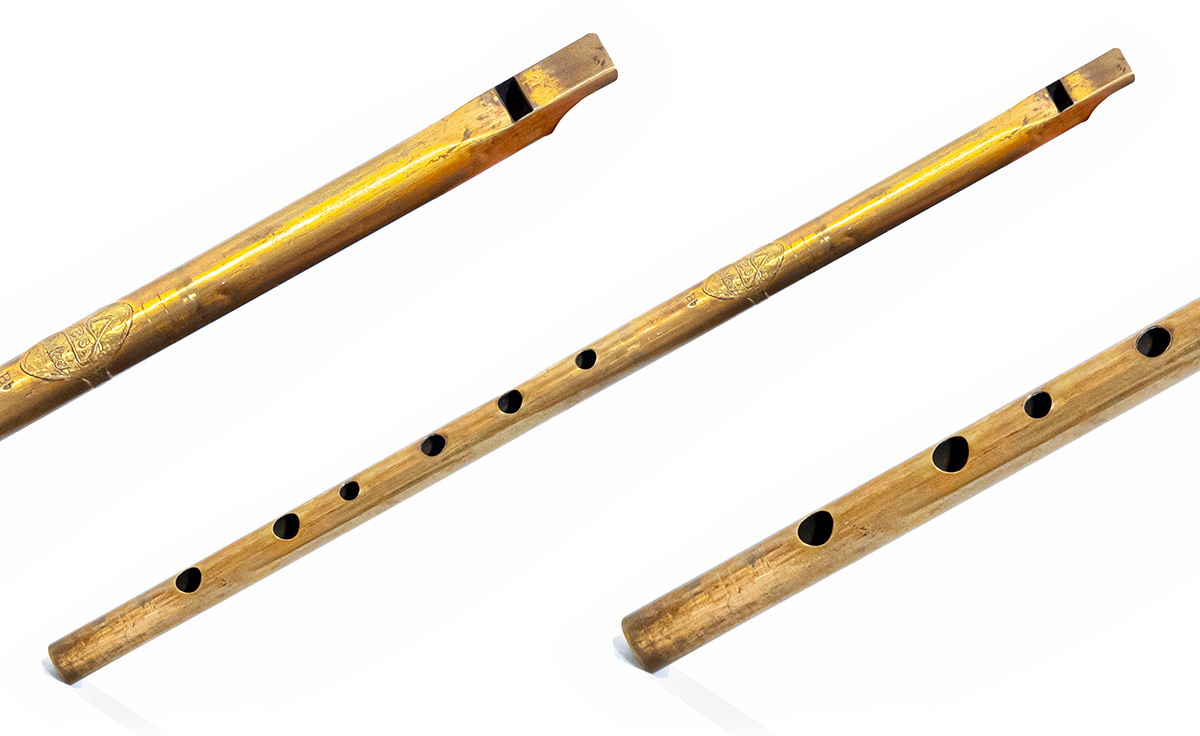
Whistle Pipe Bb by S Barnett, 35.5cm (MAM2 0024b)
Concert Flute, 1809
This concert flute was made by WH Potter, London. It is made from boxwood with ivory tips and bands. It has five sections with a graduated tuning slide, the outer tubing of which is covered with wood. It has six silver keys with soft metal (pewter) plugs and a graduated cork screw. It measures 26.5 inches.
It was originally owned by William Divine, principle flute of The Royal Artillery (Woolwich) Band, 1825-1842. William was later the Bandmaster of The Light Dragoons.
(MAM1:0044)

Concert Flute by Potter, 26.5 inches, 1809 (MAM1 0044)
Flageolet, 1876
This flageolet was made by Riviere & Hawkes, London. It is made of four sections of rosewood. It measures 33cm.
(MAM1:0040)

Flageolet by Riviere & Hawkes, 33cm, 1876 (MAM1 0040)
Galoulet, undated
This French galoulet, also known as a tabor pipe, was made by Taylor. It is made of boxwood and has two finger holes and one thumb hole. When played it obtains a diatonic scale of 1.5 octaves from G to C. It measures 32cm.
It is known in Germany as the ‘one-handed flute’ and is held and fingered with the left hand, leaving the right hand free to beat the tabor hung in the crook of the left arm. Travelling mistrels and troubadours are often depicted playing these instruments.
(MAM1:0023)

Galoulet by Taylor, French, 32cm (MAM1 0023)
Bassoon, 1840
This bassoon was made by D’Almaine & Co, formerly Goulding & D’Almaine, London. It is made of four sections of wood with six brass keys.
(MAM1:0096)

Bassoon with 6 Keys by D'Almaine, 1840 (MAM1 0096)
Clarinet Bb, 1790
This clarinet was made by Goulding & Co, London. It is made of five sections of boxwood with five metal keys and six iovery bands. The wooden mouthpiece is inscribed ‘I. WOOD FECIT’ which indicates that it was made by John Wood who was famous for making mouthpieces and keys.
(MAM1:0074)

Clarinet, Bb, by Goulding, Two, 1 Wood Joint, 1790 (MAM1 0074)
Flageolet, 1733
This flageolet was made by Anciuti of Milan (fl.c.1717-c.1740).
It is made of a single section of boxwood and has a series of two finger holes on the front and two thumb holes on the back. At the lower end on the back there are a further three holes. It measures 35.5cm.
(MAM1:0021)
Flageolet, Double by Anciuti, 35.5cm, 1733 (MAM1 0021)
Fife Bb, 1700s
This fife is made of one section of boxwood with two bands made of brass. It measures 35.5cm.
(MAM1:0022)
